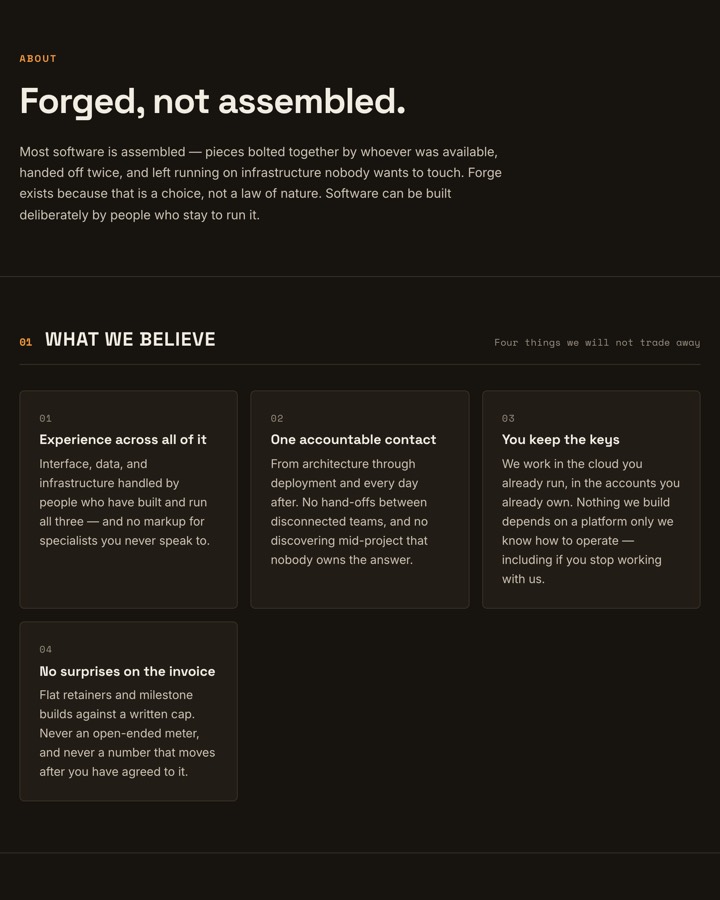
Experience across all of it
Interface, data, and infrastructure handled by people who have built and run all three — and no markup for specialists you never speak to.
About
Most software is assembled — pieces bolted together by whoever was available, handed off twice, and left running on infrastructure nobody wants to touch. Forge exists because that is a choice, not a law of nature. Software can be built deliberately by people who stay to run it.
Interface, data, and infrastructure handled by people who have built and run all three — and no markup for specialists you never speak to.
From architecture through deployment and every day after. No hand-offs between disconnected teams, and no discovering mid-project that nobody owns the answer.
We work in the cloud you already run, in the accounts you already own. Nothing we build depends on a platform only we know how to operate — including if you stop working with us.
Flat retainers and milestone builds against a written cap. Never an open-ended meter, and never a number that moves after you have agreed to it.
Forge was designed around one goal: solving software problems for companies that do not have the means or the resources to solve them alone.
We have spent more than a decade not just building solutions, but being a solutionist. Every engagement has started the same way: someone needed a problem solved that their own team was not set up to solve.
Forge is deliberately small. Small enough that the person who scopes your work is the person who does it, and that you are never handed to a team you did not agree to. When a project needs more hands, they are engineers we have worked with before — and the accountability stays here.
I believe in building foundational software over phantom systems. Our focus from the beginning is to create something that lasts.
Building a customer management platform for auction management teams — narrow enough that getting it wrong was obvious, and getting it right meant learning how the business actually ran, not just reading the spec.
Then to data teams — moving what they depended on from on-site systems into the cloud without losing the thread of what the numbers meant.
Then to the infrastructure itself, solving deployment and observability problems: getting software out reliably, and being able to see it once it was there.
And most recently across whole integrated systems — cost optimization and performance, where the answer is rarely one service and never one team.
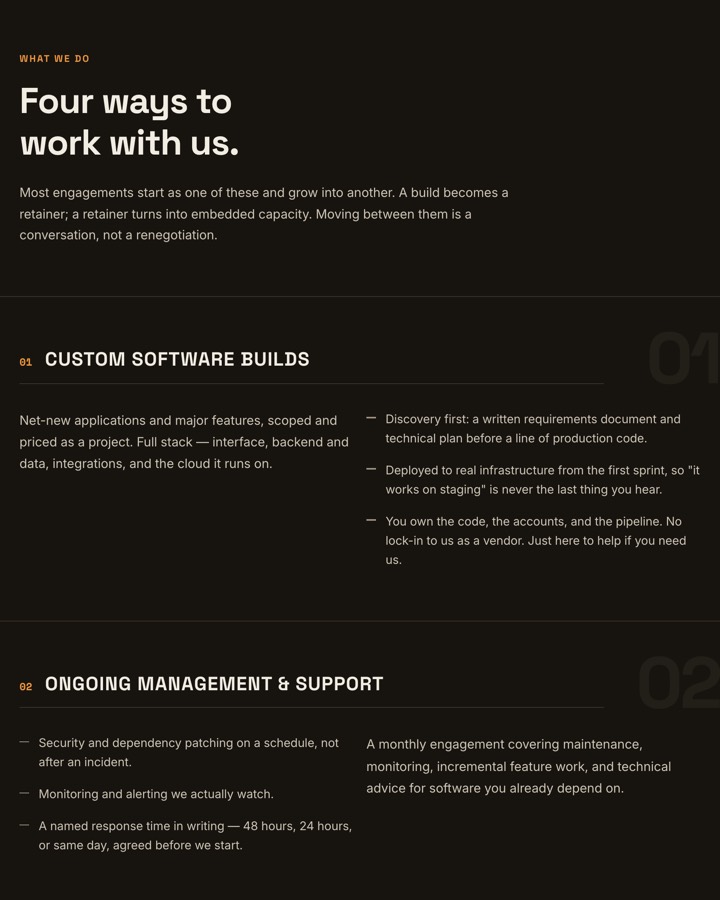
A short paid engagement — one to two weeks — that produces a requirements document, a technical plan, and a real estimate. Credited toward the project if you proceed.
Working software in front of you throughout, not at the end. Deployed to real infrastructure from the first sprint, with the CI/CD and observability built in rather than bolted on.
Software is not finished when it ships. A support retainer keeps it patched, monitored, and improving — with the same people who built it.
Run is the part most shops treat as someone else's problem. It is the reason Forge exists — software is not finished when it ships, and the people who built it are the ones who should keep it standing.
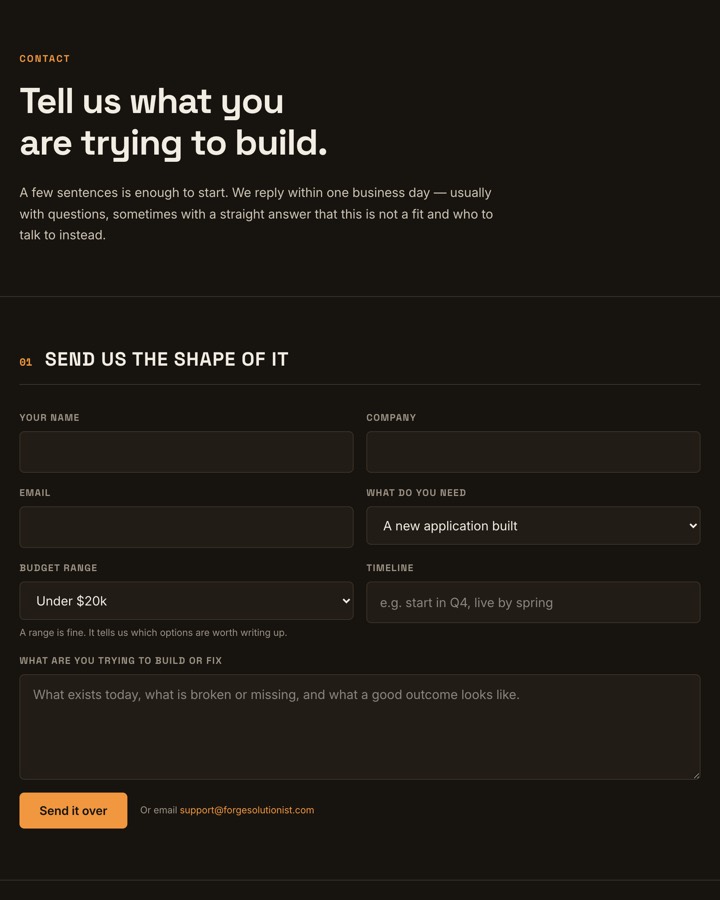
Tell us what you are trying to build, or what is already built and giving you trouble. We reply within one business day — including when the honest answer is that we are not the right fit.